


Launching or scaling an intimate apparel brand is a notoriously challenging endeavor. Unlike general apparel, intimate garments demand unparalleled precision in fit, comfort, and durability. In 2024 and beyond, the market is no longer satisfied with generic, mass-produced items. To truly capture a demographic and build lasting brand loyalty, entrepreneurs must look toward custom bra production and private label lingerie as their core strategies for differentiation and scalability.
But where do you start, and what is the real cost of entry? The intimate apparel supply chain can seem opaque, but understanding the nuance between private label (taking an existing design and rebranding it) and true custom (creating from a blank canvas) is your first step to success.
Defining the Landscape: Custom Bra Production vs. Private Label Lingerie
The terms are often used interchangeably, but for a brand manager, they represent very different investment levels and market positioning.
What is Private Label Lingerie?
Think of private label as the accelerated route to market. When you partner with a manufacturer for private label lingerie, you are utilizing their proven, pre-existing patterns, materials, and production lines. The “customization” comes in at the rebranding stage: you add your label, your tags, select your colorways, and perhaps make minor packaging adjustments.
The Benefits:
-
Speed to Market: You skip the lengthy product development cycle (prototyping, fit tests, pattern making).
-
Lower MOQs (Minimum Order Quantities): Since the factory is already making these items, they can often offer smaller batches.
-
Proven Fit: The manufacturer has already vetted the fit on live models, reducing your risk of fit issues.
What is Custom Bra Production?
Custom bra production (often called OEM or ODM) is a deep-dive development process where the garment is built according to your unique tech packs. You specify the fabric blend, the specific hardware, the foam cup type, the stitching methods, and, critically, your own unique grading (the measurement jump between sizes).
The Benefits:
-
True Brand Differentiation: Your products will not be identical to any other brand.
-
Quality Control: You own every component of the supply chain.
-
Solve Specific Problems: You can design specifically for niche markets (e.g., postpartum, post-mastectomy, high-impact athletic, or ultra-specific size ranges).
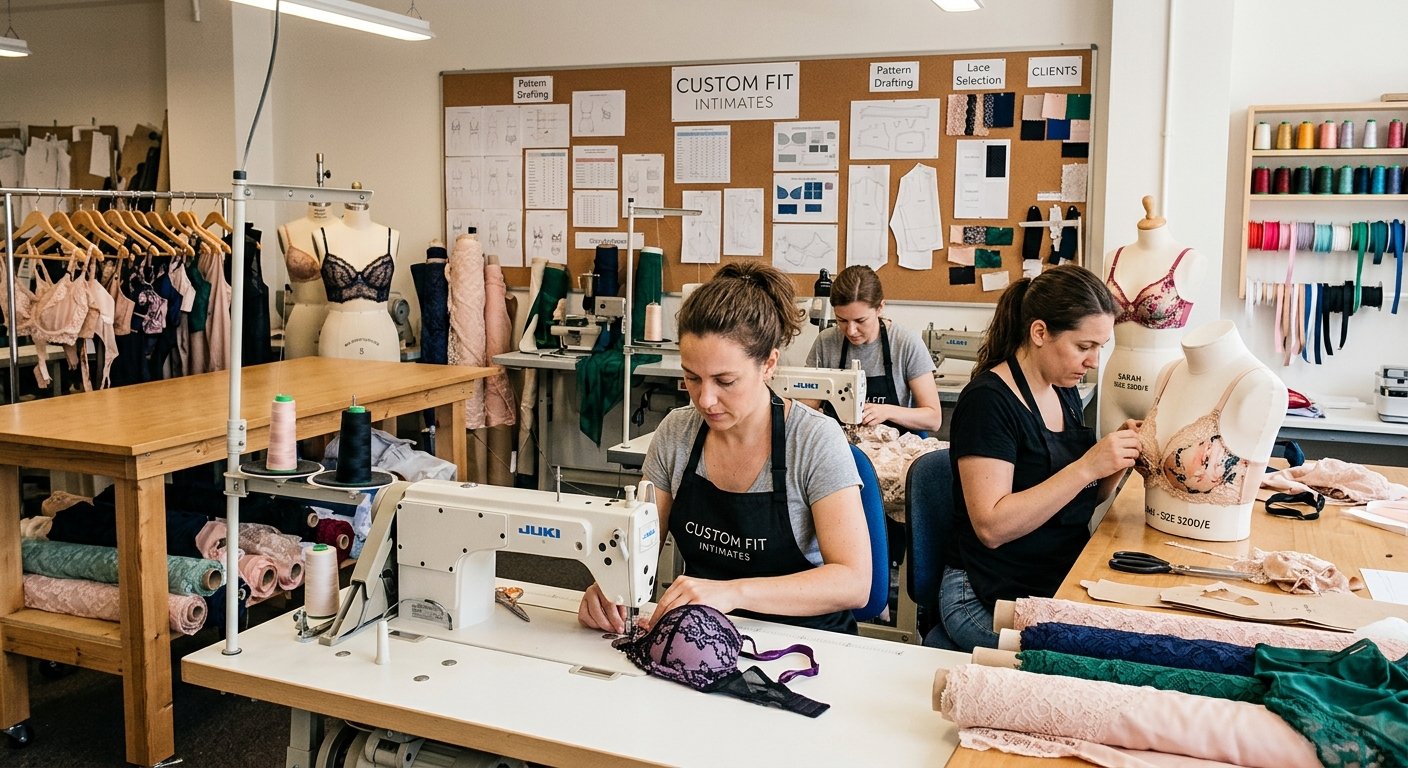
Why Custom Bra Production is Essential for Long-Term Growth
While private labeling is great for testing the waters, long-term brand equity is almost always built on the back of unique product development. This is especially true in a product category where functionality is as important as aesthetics.
1. Solving the Fit Dilemma
The number one reason for customer returns and negative reviews in intimate apparel is poor fit. By embracing custom bra production, you aren’t tied to the generic “small, medium, large” grading of a factory model. You can work with a specialist pattern maker to develop a grading system that solves the specific frustrations of your target demographic—whether that’s offering closer wire grading, varied band-to-cup ratios, or straps that actually stay put. A proprietary fit is your marketing strategy.
2. Fabric and Tech Innovation
If your brand promise is sustainability, you can’t just private label a standard polyester bra. You need custom sourcing for Tencel, organic cotton, or recycled nylon. Furthermore, if you are looking to enter the high-growth Activewear Bra or Shapewear sectors, custom production is non-negotiable. You need to spec the specific GSM (grams per square meter) of fabric, the exact percentage of spandex, and advanced techniques like seamless bonding or laser-cut edges to compete with market leaders.
Navigating Private Label Lingerie as a Starter Strategy
For a new brand or one looking to test a new product line without massive R&D investment, private label lingerie offers an excellent proof-of-concept. The key is in how you select and market these items.
1. Sourcing Quality Private Label
Do not just select the cheapest items from a generic global directory. A professional manufacturer like BCUnderwear will have distinct, curated private label collections. Ask for samples. Check the stitching. Wash the samples five times. If they hold their shape and the elastic remains taut, they are brand-worthy.
2. Market Differentiation (The “Label” Part of Private Label)
If you can’t change the stitch, change the story. Differentiate your private label collection through:
-
Branding: Unique packaging, storytelling, and digital marketing.
-
Customer Experience: Rapid shipping, easy returns, and detailed fit guides.
-
Curation: Don’t just list 50 styles; curate a capsule collection that speaks to a specific lifestyle.
Crucial Steps Before Engaging a Manufacturer
Whether you choose private label lingerie or custom bra production, a professional factory requires you to be professional, too.
1. The Tech Pack (Custom Only)
This is your product blueprint. For custom production, you need a detailed Tech Pack specifying everything: BOM (Bill of Materials), grade rules, point of measurement sheets, and stitch types. While some manufacturers can help develop this, having your own protects your intellectual property.
2. Sampling and Fit Verification
This is the most time-consuming part of custom bra production. You will likely go through 2-4 rounds of prototyping. The first sample (proto 1) is often just for construction. Later samples (fit samples) must be tested on live models of your target demographic, not just mannequins. If your target is active women, they need to jump, run, and stretch in the sample.
3. Clear Communication on MOQs and Pricing
Always understand the tiered pricing structure. For true custom work, MOQs will be higher (often 1000-3000 units per style) because the factory must source custom components and set up dedicated production lines. Private label MOQs are typically much lower (sometimes as low as 100-300).
Conclusion: Partnering for Success
In the intimate apparel industry, your factory partner is as vital as your marketing team. You need a manufacturer that understands the technical complexities of bra engineering, whether you are utilizing their private label lingerie models or requiring full-scale custom bra production.
Are you a brand manager ready to take the next step in product development? BCUnderwear specializes in both pathways, offering expert-led private label curation and specialized OEM manufacturing for full custom lines, including Activewear and Shapewear.
Let’s discuss your vision. Explore our manufacturing capabilities at BCUnderwear.com and let’s build a foundation for your brand’s success.