


Navigating a major apparel exhibition can be overwhelming, especially when your primary goal is high-precision seamless underwear sourcing. Unlike conventional cut-and-sew intimate apparel, stitchless garments rely heavily on complex circular knitting machinery, precise yarn tensioning, and advanced thermal bonding technology. A visual inspection on a trade show floor isn’t always enough to distinguish between a garment that will hold its shape after fifty laundry cycles and one that will fall apart after two.
Whether you are an established brand owner looking to transition into ultrasonic bonding or a startup seeking low-MOQ partners, knowing how to evaluate potential suppliers on the exhibition floor is critical. This guide breaks down the exact practical steps for sourcing seamless intimates effectively, verifying factory capabilities, and avoiding costly sampling errors.
Why Sourcing Seamless Apparel Demands a Unique Strategy
Traditional bra and brief construction relies on standardized cut-and-sew patterns. If a seam sits slightly off, a master seamstress can often adjust the tension or recut the panel. Seamless garments, however, are engineered directly from machine to tube using computerized Santoni-type circular knitting or laser-cut bonding methods.
When executing seamless underwear sourcing at an apparel exhibition, you aren’t just evaluating a finished product—you are evaluating a factory’s technical infrastructure.
Because adjustments require re-programming machinery or adjusting chemical adhesive temperatures rather than simply altering a stitch line, choosing the right partner upfront saves months of delayed product launches.
5 Essential Steps to Evaluate Seamless Suppliers at Trade Shows
1. Perform the “Stretch & Snap” Stress Test
When holding a seamless sample at a booth, don’t just feel the hand-feel of the fabric.
-
Stretch the waistband and leg openings horizontally to their maximum capacity.
-
Observe how quickly the fabric recoils. High-quality spandex blends (such as 70/30 nylon-spandex mixes) should snap back instantly without leaving visible white stress lines across the knit.
-
For bonded garments, run your fingernail firmly along the fused edge. If you detect any lifting, bubbling, or sticky adhesive residue, the factory’s bonding temperature or pressing duration was improperly calibrated.
2. Inspect the Inner Gusset Construction
The gusset is the ultimate test of a factory’s seamless precision. In lower-grade manufacturing, inner cotton liners are simply flatlocked onto the synthetic body, creating bulky edges that defeat the purpose of “seamless” design. Premium manufacturers use clean, heat-sealed bamboo or organic cotton gussets that lie completely flat against the skin.
3. Ask About Machine Gauge and Needle Density
When chatting with factory representatives at their booth, skip generic questions like “Is your quality good?” Instead, ask about technical specifications:
-
“What machine gauges do you run for your seamless line?” (A higher gauge, such as 28G or 36G, indicates a denser, softer, and less see-through knit).
-
“Do you use Italian Santoni machines or local equivalents?” (Santoni machines offer significantly tighter tension control and consistency across size gradations).
4. Verify In-House Testing Capabilities
A reputable factory doesn’t rely solely on third-party labs for basic quality control. Inquire if they perform in-house wash testing (usually 20 to 30 cycle tests for bonded adhesives), burst-strength testing, and color-fastness verification before shipping bulk orders.
5. Review Raw Material Traceability
If your brand claims moisture-wicking or cooling properties (such as ice silk or recycled micro-polyamide), ask the representative for yarn supplier certifications (e.g., GRS for recycled fibers, Oeko-Tex Standard 100 for chemical safety).
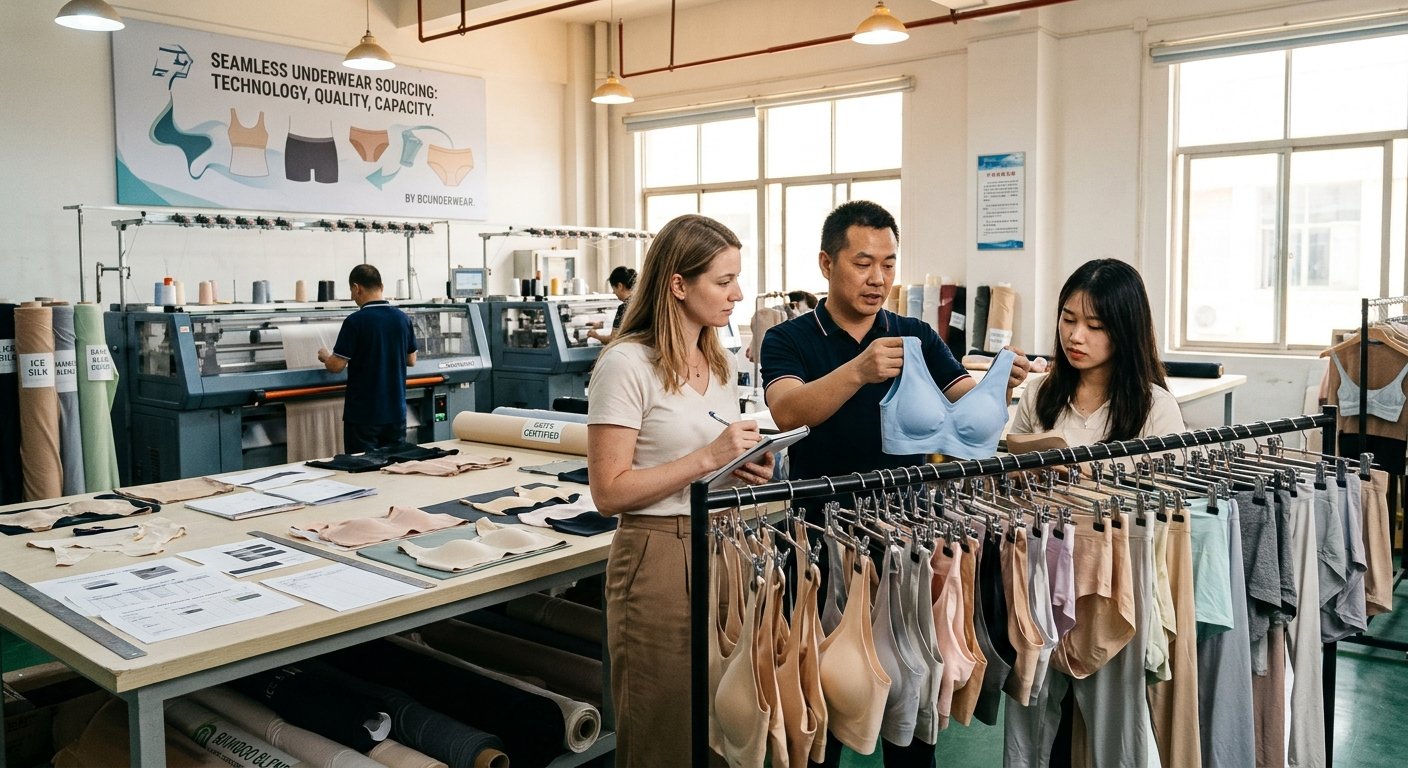
Transitioning from Exhibition Booth to Bulk Production
Meeting a supplier at an apparel exhibition is only the first handshake. To ensure your seamless underwear sourcing project stays on track post-show, follow this structured timeline:
Step 1: Request Pre-Developed Counter Samples
Rather than asking the factory to create a custom sample from scratch immediately after the show, request two or three counter samples from their existing stock. This allows you to test their off-the-shelf fit, fabric weight, and bonding quality within a week.
Step 2: Test Live Wear and Machine Laundry
Once your custom prototypes arrive, put them through real-world conditions. Have fit models wear them during active workouts and run them through standard washing machine cycles. If bonded seams begin to delaminate or waistbands roll down during movement, feed this feedback directly to the factory’s engineering team.
Step 3: Clarify MOQs vs. Colorways
Seamless circular knitting requires dedicated machine setup time per color. While a factory might offer a low total Minimum Order Quantity (e.g., 1,000 pieces per style), they may require 500 pieces per colorway to justify dyeing and yarn loading. Clarify these details before signing your production contract.
Why Partner with BCUnderwear?
At BCUnderwear, we bridge the gap between technical innovation and scalable manufacturing. Specializing in advanced seamless knitting, ultrasonic thermal bonding, and cooling ice silk fabric integration, we help global brands transform concepts into market-ready intimates.
Whether you missed us at the latest apparel exhibition or are preparing your upcoming collection’s seamless underwear sourcing strategy, our engineering team is ready to assist with tech packs, low-MOQ sampling, and OEM/ODM production.
Ready to elevate your intimate apparel line? Visit BCUnderwear.com to request a sample kit or schedule a private virtual consultation today!
❓ Frequently Asked Questions
Q: Why are sampling lead times longer for seamless underwear than standard bras?
A: Seamless garments require setting up specialized circular knitting cylinders, programming specific tension patterns, and adjusting thermal bonding molds. Once set up, however, bulk production moves significantly faster than traditional sewing.
Q: What is the ideal fabric blend for seamless daily underwear?
A: A blend of 75% Micro-Nylon (Polyamide) and 25% Elastane (Spandex) typically delivers the optimal balance of silky softness, 4-way stretch, and long-term shape retention.
Q: Can bonded seamless bras support larger cup sizes?
A: Yes. By incorporating multi-layer fused fabrics, targeted dot-matrix adhesive patterns, and ergonomic side-boning, modern bonded bras provide comfortable lift without needing traditional metal underwires.